The Build Price Is Only One Part Of The ARU Budget
Many homeowners start by asking what a garden suite or backyard home costs to build. That is the right question, but it needs more than a model price. A detached ARU budget should include the unit, utility connections, design and engineering, permits, rental licensing, site work, financing, insurance, possible development charge review, and property tax reassessment.
A property can look simple from the backyard and still become expensive if services are far away, access is tight, trees are in the way, grading is difficult, or zoning forces a smaller custom layout.
A Quick Cost-Bucket Snapshot
Before you compare builder quotes, separate the project into the parts that are easiest to underestimate.
- Build the unit - shell, foundation, framing, exterior, interior finishes, and mechanical systems
- Make the lot work - trenching, access, grading, trees, drainage, and restoration after construction
- Carry the project - design, permits, rental licence, insurance, financing, tax risk, and development charge review
If one bucket is still unknown, the quote is not ready to compare against a real budget.
Use Model Prices As A Starting Point, Not A Final Budget
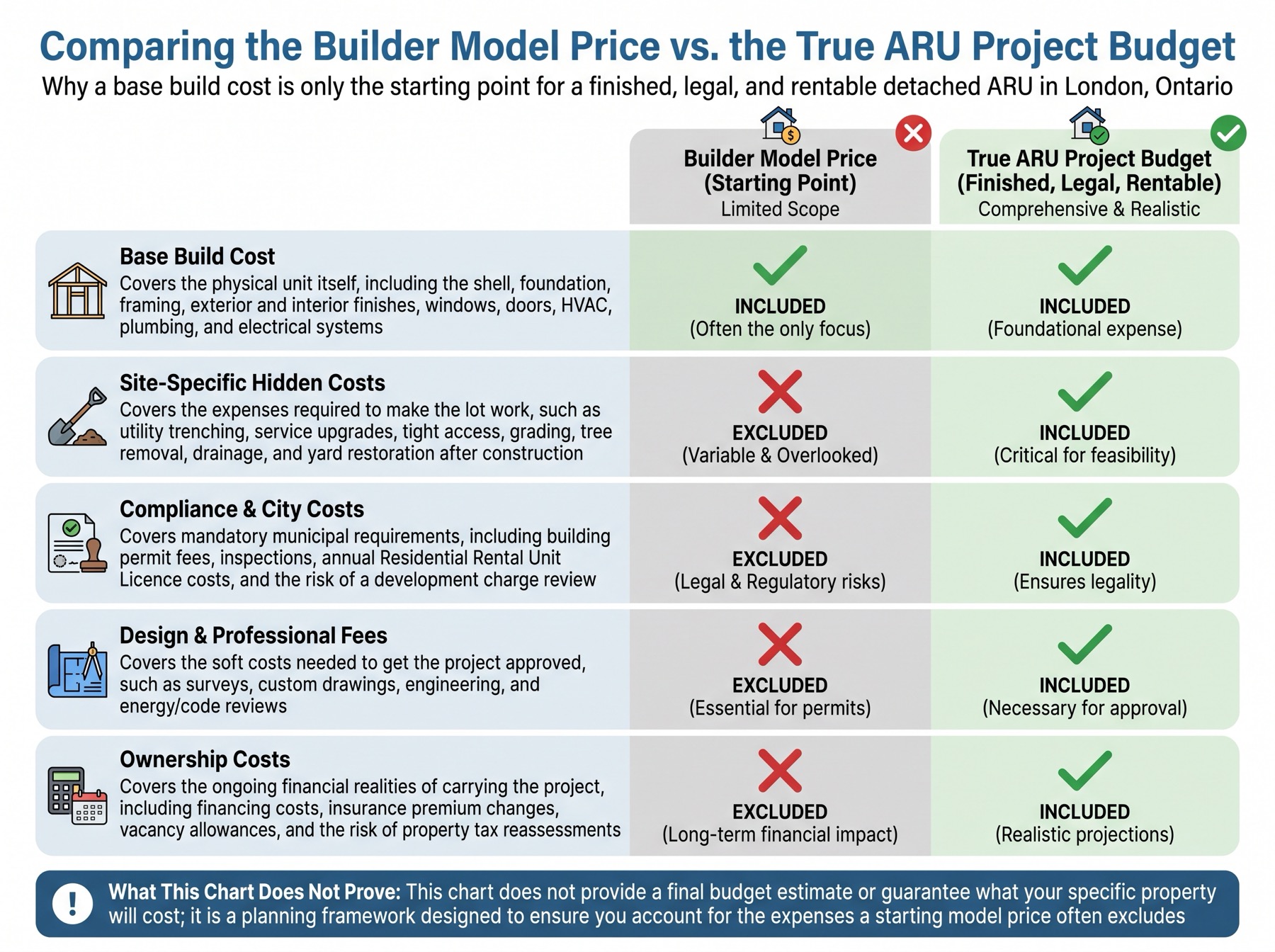
Local competitors often publish model or starting prices for backyard homes and garden suites. These can be useful for early planning, but they may not include HST, utility connections, trenching, servicing upgrades, site access, drawings, engineering, permits, rental licensing, insurance, development charges, or property-specific work.
A starting price is not the same thing as a finished, legal, rentable ARU on your property.
The Main Cost Buckets To Plan For
A realistic budget gets clearer once you separate the project into its main cost buckets.
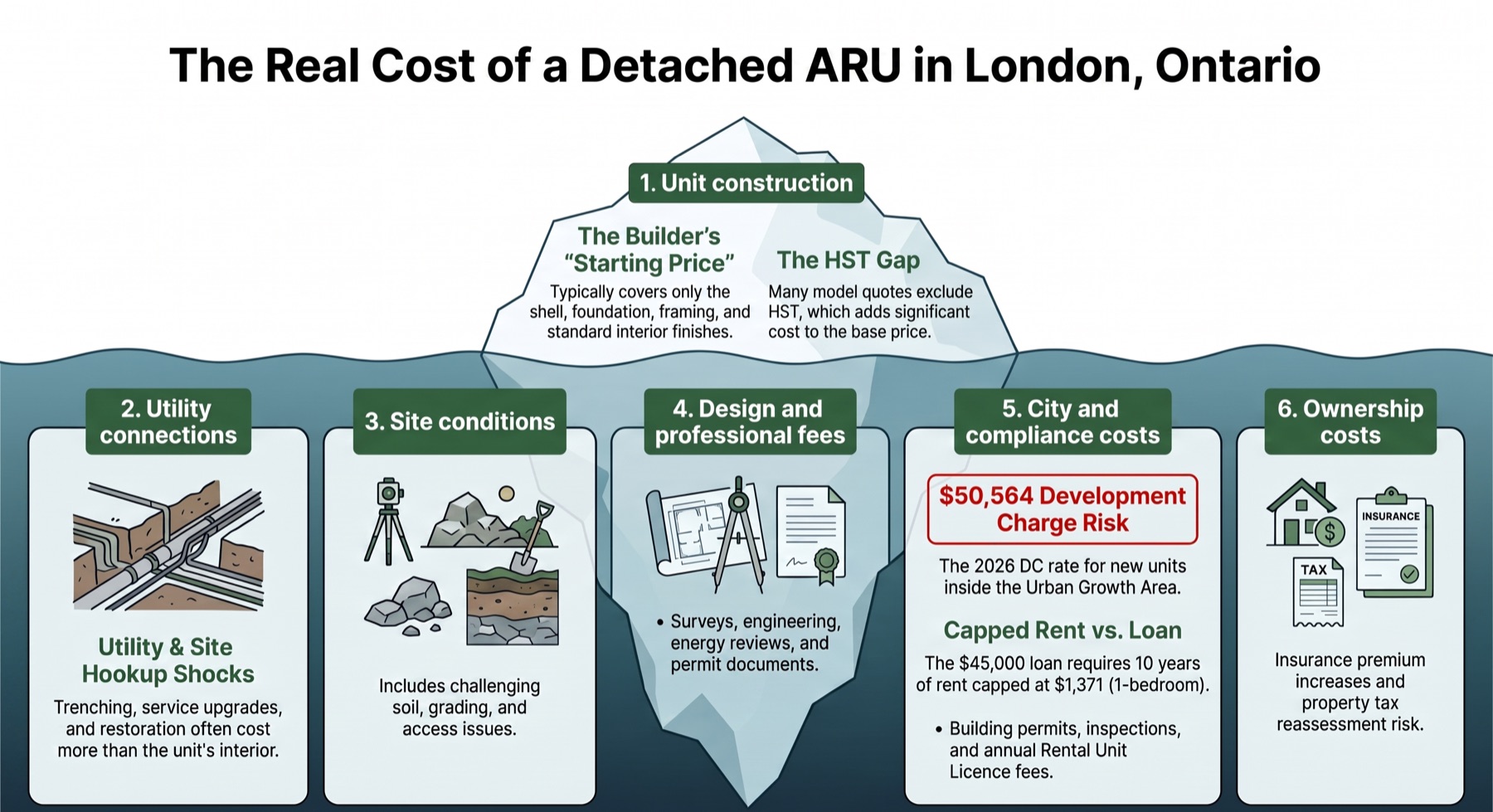
- Unit construction - The shell, foundation, framing, exterior, interior finishes, windows, doors, HVAC, plumbing, electrical, and final building work.
- Utility connections - Water, sanitary, hydro, gas, internet, trenching, service capacity checks, meters, panels, and final connection work.
- Site conditions - Access, grading, slope, trees, fences, drainage, soil conditions, crane or delivery requirements, and yard restoration.
- Design and professional fees - Survey, drawings, designer, engineering, energy/code review, permit documents, and revisions.
- City and compliance costs - Building permits, rental licence fees, inspections, possible development charge review, and other municipal requirements.
- Ownership costs - Insurance changes, financing costs, contingency, maintenance, vacancy, utilities, and possible property tax reassessment.
Utility Hookups Can Be The Hidden Budget Shock
Detached ARUs usually need a practical route for water, sanitary, hydro, gas, and internet. The distance from the main house, trenching path, capacity of existing services, grading, obstructions, and restoration work can materially change the project cost.
This is why two similar-looking backyard units can have very different final budgets. One site may have a simple service route, while another may require expensive trenching, upgrades, or access work.
Development Charges: Do Not Assume Automatic Exemption
London’s ARU development charge rules can be favourable in some situations, but eligibility is not something homeowners should assume. The City reviews development charge treatment through the permit process, and detached ARU exemptions can depend on the exact project and property facts. Review the development charges guide before you underwrite the project as exempt.
A development charge exemption can be worth a lot, but the wrong assumption can distort the budget. Treat DCs as a review item until confirmed.
How The $45,000 ARU Loan Fits Into The Cost Picture
The London ARU loan or $45,000 Affordable ARU Construction Grant can help eligible homeowners, but it does not remove the need for upfront budgeting. The program has eligibility, timing, affordability, rent-cap, owner-occupancy, rental licensing, and compliance rules.
In practical terms, the loan may reduce the long-term funding gap, but homeowners should still plan for deposits, drawings, permits, servicing, construction progress payments, contingency, and cash flow before the funding is received.
The Cost Only Makes Sense If The Rent Math Works
If the project relies on the $45,000 Affordable ARU Construction Grant, rent is capped at 100% of CMHC Average Market Rent during the affordability period. That means the cost plan should be tested against capped rent, not unrestricted market rent. Use the rent cap calculator before you rely on a builder number.
- Current planning value used on this site: 1-bedroom ARU at $1,371/month
- Current planning value used on this site: 2-bedroom ARU at $1,651/month
Verify current CMHC Average Market Rent values before applying, because rent-cap numbers can change over time.
Budget For Possible Property Tax Reassessment
Adding a detached dwelling or making major improvements can affect property assessment. Building permits and new secondary structures may trigger review, and homeowners should plan for the possibility of a future property tax change.
This page cannot estimate your tax change. Treat property tax reassessment as a budget risk to confirm before relying on the final return.
Insurance And Financing Should Be Checked Early
A detached ARU can change the risk profile of the property. Homeowners should ask their insurer how a legal rental unit may affect coverage and premiums. Financing should also be reviewed early, especially if the homeowner is relying on home equity, refinancing, or construction-stage cash flow.
The City loan is only one part of the funding stack. The rest of the project still needs a realistic financing plan.
A Simple ARU Budget Framework
Use this framework before comparing builder quotes:
- Base unit or model price
- HST, if applicable
- Foundation or site prep
- Utility trenching and hookups
- Service upgrades, if needed
- Survey, drawings, design, and engineering
- Building permit and inspections
- Rental licence costs
- Development charge review or risk
- Tree, access, grading, drainage, and restoration work
- Insurance changes
- Financing costs
- Property tax reassessment risk
- Contingency
If a quote does not clearly address these items, ask what is included, excluded, estimated, or still subject to site review.
Common Cost Mistakes Homeowners Make
The biggest budget misses usually happen before construction starts.
- Only comparing model prices - A lower starting price may not include servicing, site work, drawings, permits, licensing, or property-specific requirements.
- Ignoring utility routes - Trenching, service capacity, meters, panels, and restoration work can materially change the final budget.
- Assuming funding solves the cash-flow gap - The City says homeowner construction-grant funding is issued after the ARU is constructed and an agreement is signed, while the repayable ARU Loan is issued after the unit is created and paid for in full. Upfront planning still matters.
- Forgetting capped rent - If the Affordable ARU Construction Grant is part of the plan, test the budget against the applicable CMHC capped rent.
- Treating DC exemptions as guaranteed - Development charge treatment should be reviewed through the City process before relying on an exemption.
FAQ
Common questions, answered plainly
How much does it cost to build a detached ARU in London, Ontario?
The cost can vary widely depending on the plan, size, construction method, servicing route, access, site conditions, permits, design, engineering, insurance, tax reassessment, and development charge review. Use published model prices only as a starting point, not a final budget.
Is the London ARU grant really free money?
The City currently describes a $45,000 Affordable ARU Construction Grant. It is conditional support, not automatic funding. Homeowners still need to plan for deposits, permits and construction cash flow, and must follow the current agreement’s applicant, affordability, rental and compliance rules.
Are detached ARUs exempt from London development charges?
Development charge exemptions for detached ARUs should not be treated as automatic. The City provides exemption pathways for some additional-unit setups, but Building Services confirms the treatment through permit review. For 2026, the standard development charge schedule lists major rates such as $50,564 for a new single or semi-detached unit inside the Urban Growth Area and $30,306 for a 2+ bedroom apartment, so homeowners should keep DC treatment as a budget review item until confirmed.
What are the hidden costs of building a detached ARU in London?
A builder's base model price generally covers the physical unit, not the full project budget. Common hidden costs include utility connections and trenching, site access, grading, trees, surveys, custom drawings, engineering, building permits, rental licence fees, development charge review, insurance changes, financing costs, and possible property tax reassessment.
How does the CMHC rent cap affect the $45,000 London ARU loan?
If the project relies on the $45,000 Affordable ARU Construction Grant, the budget should be tested against capped rent, not unrestricted market rent. The current planning values used on this site are $1,371/month for a 1-bedroom ARU and $1,651/month for a 2-bedroom ARU. Homeowners should stress-test the project after vacancy, financing, insurance, maintenance, utilities, and taxes, and verify current CMHC values before applying.
Do CMHC pre-approved garden suite plans skip the London permit process?
No. CMHC catalogue plans can provide a useful design starting point, but they do not guarantee City of London approval. The design still needs to be adapted to the specific lot and reviewed for London zoning, setbacks, lot coverage, servicing, bedroom-count limits, permit requirements, and the Ontario Building Code.
Is a modular ADU cheaper than a custom build?
It can be, but not always. Modular or prefab options may reduce some construction complexity, but site prep, foundation, delivery, crane access, servicing, permits, design adaptation, and local requirements still matter.
Should I get a builder quote before checking zoning?
You can speak with builders early, but do not rely on a quote until zoning, setbacks, lot coverage, servicing, access, and permit requirements have been reviewed.
What costs are most often missed?
Commonly missed costs include utility trenching, service upgrades, design revisions, engineering, rental licensing, insurance changes, development charge review, grading, trees, access, restoration, financing costs, vacancy, maintenance, and property tax reassessment.
Check The Lot Before You Trust The Cost
Run the quick site screen to check the early zoning, lot coverage, servicing, owner-occupancy, and rent-cap questions before relying on a model price or builder estimate.
Run The Quick Site Screen Use The Rent Cap Calculator