Short Answer: Do Not Assume Automatic Exemption
Detached ARUs in London are not automatically exempt from development charges, even though some additional-unit situations may have exemption pathways. Because eligibility depends on the property's exact unit combination and building facts, homeowners should treat DCs as a pending cost until the City confirms the treatment during building permit review.
A builder estimate or blog post is not the final answer. The City confirms development charge treatment through the permit process.
Why Development Charges Matter In ARU Budgeting
Development charges are municipal fees tied to growth-related infrastructure. Because a detached ARU adds a new dwelling unit, homeowners need to understand whether the project may trigger a charge or fit one of the City’s exemption pathways.
Treat development charges as a permit-stage review item until the City confirms the treatment.
Key Facts From Official Sources
These are the source-backed facts to keep in mind before you rely on a builder quote or final project budget.
- Development charges are a potential hidden cost when a detached ARU creates a new dwelling unit.
- The 2026 development charge schedule lists $50,564 for a new single or semi-detached unit inside the Urban Growth Area.
- The 2026 schedule also lists $30,306 for a 2+ bedroom apartment inside the Urban Growth Area.
- Those rates are planning-risk examples, not guaranteed charges for every detached ARU.
- Permit facts matter: eligibility depends on the exact unit combination, building type, and City review.
The Cost Risk Can Be Large Enough To Change The Project
According to the 2026 Development Charges schedule, the rate for a new single or semi-detached unit inside the Urban Growth Area is $50,564. For apartments with 2+ bedrooms, it is $30,306. Numbers at this level can materially change whether the project still works after financing, servicing, and capped rent are considered.
Inside the Urban Growth Area, a single DC can be over $50,000.
Some ARU Setups May Qualify For Exemption Treatment
The City of London provides exemption pathways for some additional unit combinations on residential lots, including some detached ARU situations. The key point is that exemption treatment depends on the exact building type, unit count, and permit facts, so homeowners should treat it as a review item until the City confirms it.
- Exemptions may exist for units in existing residential buildings.
- Detached ARU exemptions may apply on some residential lots.
- Eligibility depends on the exact unit combination and project facts.
- The City confirms development charge treatment during permit review.
A Simple Permit-Stage Decision Tree
Use this quick screen before you budget the project as if the development charge is already settled.
- If the project creates a new dwelling unit, treat DCs as a live cost until reviewed.
- If the property may fit an exemption pathway, keep the exemption as conditional, not assumed.
- If permit facts are unclear, ask the City before you lock in pricing or financing.
Keep DCs as a live budget line item until the City confirms the treatment.
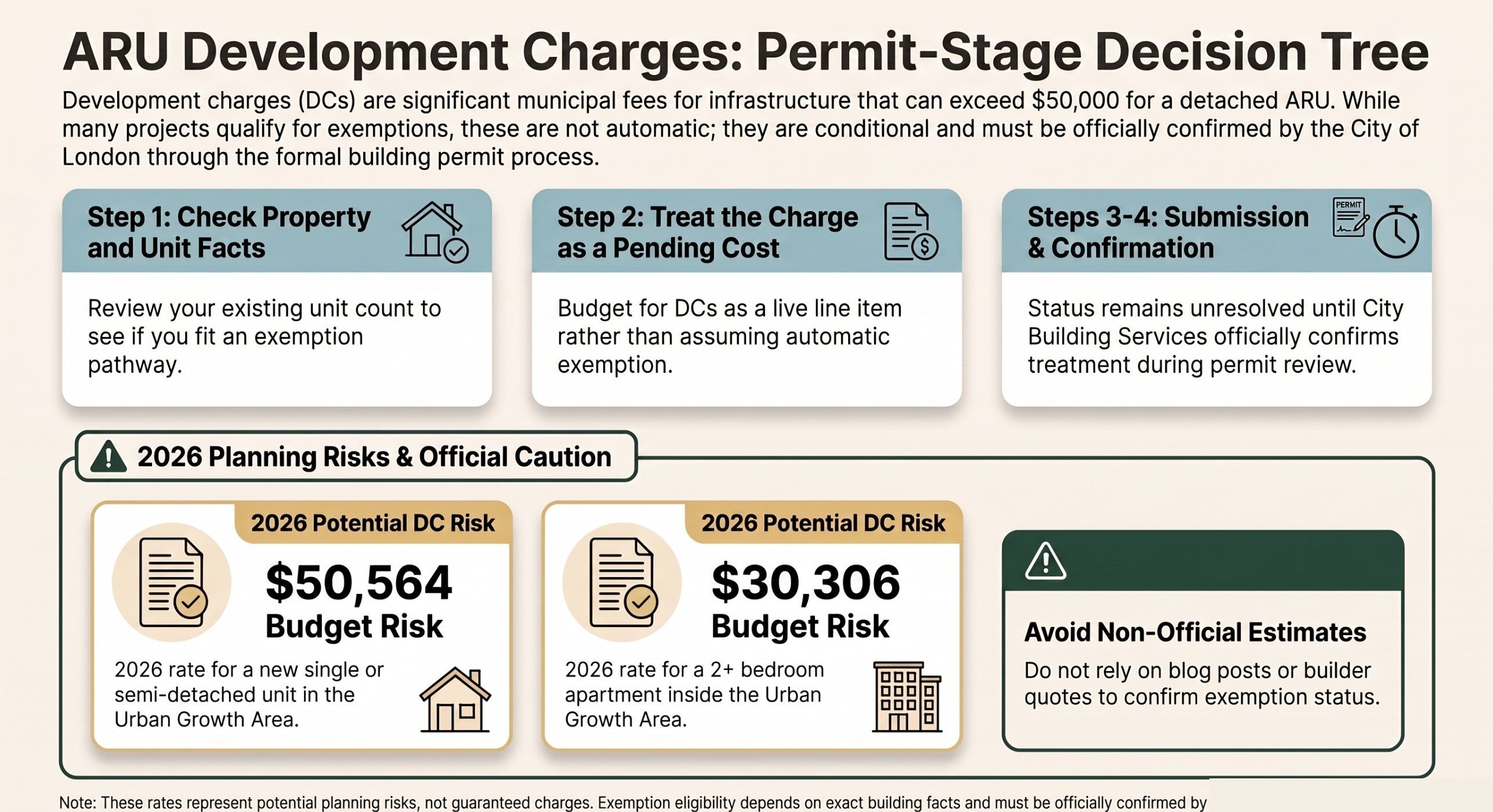
Do Not Treat Exemption As Automatic
Do not assume your project is exempt based on a blog post or a builder's estimate. The City of London Building Services team is the authority that confirms development charge treatment during the permit process. Pair this review with the cost guide and funding guide so the budget is tested against both fees and funding rules.
Common Development Charge Mistakes
The biggest development charge problems usually come from treating an unresolved permit question as if it has already been answered.
- Assuming exemption is automatic. Some detached ARU setups may qualify for favourable treatment, but eligibility depends on the unit count and project facts.
- Relying only on a builder quote. A builder may have useful experience, but the City confirms development charge treatment through permit review.
- Waiting until late in the project. Reviewing DC risk early keeps the budget conservative before pricing, financing, or contracts are locked in.
- Confusing model price with full budget. A true ARU budget should include site work, utility connections, permits, licensing, and possible development charge review.
- Forgetting the loan and rent-cap math. If the $45,000 Affordable ARU Construction Grant is part of the plan, large fees can materially change the project math because rent is capped during the affordability period.
Important Caveat Before You Rely On The Budget
This page is a planning guide, not legal, financial, or official permit advice. Your actual development charge treatment depends on the exact project facts and City review during the permit process. Confirm current rates and exemption treatment with the City before relying on final project numbers.
Side-by-side
Assume the charge versus wait for confirmation
The safer budget is the one that separates what you hope is exempt from what the City has actually confirmed.
Use the permit-stage decision tree above as a planning framework, not a final fee determination.
FAQ
Common questions, answered plainly
Do I have to pay development charges to build a detached ARU in my backyard?
Because a detached ARU adds a new dwelling unit, development charges should be treated as a live budget risk until reviewed. Some additional-unit setups may qualify for exemption treatment, but the answer depends on the exact property and permit facts.
Are garden suites and detached ARUs automatically exempt from development charges?
No. Some detached ARU situations may qualify for favourable treatment, but exemption is not automatic. The City reviews eligibility through the permit process based on the unit type, unit count, and project facts.
Who confirms whether my ARU gets a development charge exemption?
The City of London confirms development charge treatment during building permit review. A builder, blog post, or early estimate can help flag the issue, but it should not be treated as the final confirmation.
When should I check if development charges apply to my ARU project?
Check development charge risk early, before locking in pricing, financing, or builder contracts. That keeps the budget conservative while exemption treatment is still unresolved.
What are some examples of London development charges for 2026?
The 2026 development charge schedule lists $50,564 for a new single or semi-detached unit inside the Urban Growth Area and $30,306 for a 2+ bedroom apartment. These are planning-risk examples, not a guarantee that every detached ARU will be charged those amounts.
How do development charges affect the $45,000 Affordable ARU Construction Grant math?
If the $45,000 Affordable ARU Construction Grant is part of the plan, rent is capped during the affordability period. A large unresolved fee can materially change financing, cash flow, and whether the project still works under capped rent.
Can my builder confirm if my ARU is exempt from development charges?
Not reliably on their own. A builder may have relevant experience, but the City confirms the actual development charge treatment through permit review.
Does every property in London get the same development charge treatment for ARUs?
No. Development charge treatment depends on the exact unit type, existing unit count, building facts, and residential-lot conditions. Each property should be treated as its own review.
What if the permit file is still incomplete?
Treat the charge as unresolved until the file is complete enough for the City to review. Incomplete facts usually mean the DC question is still open.
Screen The Property Before You Assume A DC Exemption
The Backyard Audit helps flag whether DC treatment deserves early attention before you rely on a builder quote or a $45,000 affordable-grant plan.
Run The Backyard Audit